Learn Cebuano Pronunciation
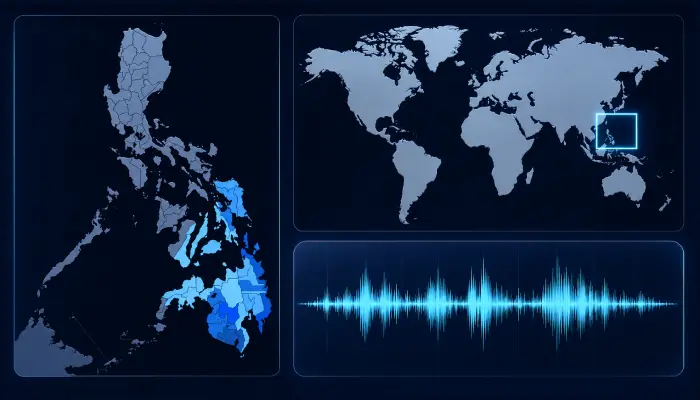
Cebuano, also known as Bisaya, has one of the most phonetically consistent writing systems among Philippine languages — yet correct pronunciation can still be difficult for learners because of stress placement, glottal stops, vowel length, and several sounds that do not exist in English. Spoken widely across Cebu, Bohol, Negros Oriental, and much of Mindanao, Cebuano relies heavily on subtle sound distinctions that are easiest to learn through listening and phonetic guidance.This Cebuano pronunciation dictionary combines native speaker audio, IPA transcription, interactive vowel and consonant charts, articulatory animations showing real-time tongue and lip position, and acoustic waveform visualization — tools designed to show you how sounds are physically made, not just describe them. It covers the full sound system, stress patterns, regional variation, and the specific sounds that consistently cause errors for English speakers. Additional information about the language and its history can be found on Wikipedia.
Cebuano Language Facts
- Native name
- Binisaya / Cebuano
- Language family
- Austronesian → Malayo-Polynesian → Philippine → Bisayan. Related to Tagalog, Hiligaynon, and Malay, but not mutually intelligible with any of them.
- Primary regions
- Cebu, Bohol, Negros Oriental, Mindanao (Davao, Cagayan de Oro, General Santos)
- Writing system
- Latin alphabet (modern; historically, a pre-colonial Visayan script known as Badlit or Suwat Bisaya was used, which is closely related to the Tagalog Baybayin). Spelling is largely phonetic — most letters correspond to one consistent sound, making written Cebuano more predictable than English or French
- Native speakers
- 25+ million — second only to Filipino/Tagalog in the Philippines, and more speakers than Norwegian, Finnish, or Danish combined, yet significantly underrepresented in language-learning resources
- Official status
- Regional language recognized under Philippine Republic Act 7104; used in regional broadcasting, local government, and education across the Visayas and Mindanao
Cebuano Words and Phrases
How to say Colors in Cebuano — Learn how to say red, blue, green and more in Cebuano, with native speaker audio and IPA transcription for each color word. Useful for shopping, describing objects, and everyday conversation.
How to say Common Phrases in Cebuano — Essential Cebuano expressions for greetings, thanking, apologizing, and getting by in daily life. Each phrase includes stress markers so you know exactly which syllable to emphasize.
How to ask Common Questions in Cebuano — How to ask where, what, why, and how in Cebuano. Includes the word-initial /ŋ/ sound in ngano (why) — one of the trickiest sounds for English speakers.
How to say Common Words in Cebuano — High-frequency Cebuano vocabulary with full phonetic breakdown. A practical starting point for building pronunciation accuracy before moving to longer phrases.
How to say Days of the Week in Cebuano — All seven day names are borrowed from Spanish, so learners with Romance language background will recognize them immediately. Includes lunes, martes, myerkules, and all others with audio.
How to say Greetings in Cebuano — How to say hello, good morning, good evening, and more in Cebuano. Covers both formal and informal registers used across Cebu, Bohol, and Mindanao.
How to say Numbers in Cebuano — Count from one to a hundred (and beyond) in Cebuano, with audio pronunciation and IPA for each number. Essential for prices, ages, phone numbers, and daily transactions.
How to say Months of the Year in Cebuano — All twelve month names in Cebuano, most borrowed from Spanish and easy to recognize for Romance language speakers. Includes enero, pebrero, marso, and the rest with native speaker audio.
Cebuano Pronunciation Guide
| Bilabial | Alveolar | |
| Plosive | ||
| Nasal | ||
| Tap or Flap | ||
| Fricative | ||
| Lateral approximant |
| Palatal | Velar | Glottal | |
| Plosive | |||
| Nasal | |||
| Fricative | |||
| Approximant |
A note on the vowel /a/
When you explore the vowel chart above, you may notice /a/ is plotted in the front column. In practice, Cebuano /a/ is often pronounced closer to [ä] — a central vowel — than true front [a].
This is very common in phonology:
- /a/ = phonemic category
- [a] or [ä] = exact pronunciation
So for Cebuano:
- phonemically: /a/
- phonetically: often [ä], sometimes slightly fronted toward [a]
That’s why you may see descriptions calling it “central” even though the IPA symbol a itself is located in the front-vowel area of the chart.
Cebuano Stress Patterns and Pronunciation Rules
Stress in Cebuano is not decorative — it is lexically contrastive, meaning the same sequence of sounds can carry entirely different meanings depending on which syllable is prominent. The words tuó (IPA: /tuˈʔo/ — How to say right in Cebuano , as in a direction, as in i-tuo, "turn right") and túo (IPA: /ˈtu.ʔo/ — to believe or trust) are distinguished in spoken Cebuano entirely by stress placement. Notice that both words contain exactly the same phonemes in the same order, including the internal glottal stop between the two vowels. The only structural difference between navigating a street corner and declaring your faith in someone is whether your voice dwells on the first syllable or the second. Learners who treat stress as optional will produce comprehension errors in everyday speech.
The default stress position is the penultimate syllable. Most words follow this pattern — for example lunes (Monday) is stressed LU-nes, not lu-NES. When a word carries final stress instead — like pula where the final syllable is prominent — that must be learned word by word.
Duration is the dominant cue. Acoustic research by Xu (2020) found that stressed syllables are on average 54 milliseconds longer than adjacent unstressed syllables — a large, perceptually clear difference. Pitch and loudness also rise slightly on stressed syllables, but these effects overlap considerably. The practical rule: listen for length, not volume.
Sounds That Are Difficult for English Speakers to Pronounce in Cebuano
The flap /ɾ/ is one of the first stumbling blocks. This is the same sound as the fast "d" or "t" in American English butter or ladder, not the full English "r." Cebuano martes (Tuesday) uses this sound — the tongue tip briefly taps the ridge behind the upper teeth and releases immediately. Holding or trilling the sound is a common error that marks a speaker as foreign.
The velar nasal /ŋ/ appears at the beginning of words in Cebuano, which never happens in English. English speakers are comfortable with /ŋ/ at the end of words (as in sing), but producing it word-initially — as in ngano (why) — requires practice. The back of the tongue lifts to the soft palate before any vowel sound begins. Starting the word with a vowel and trying to add the nasal afterward does not work; the closure must come first.
The glottal stop /ʔ/ is a full consonant in Cebuano, not a filler or pause, though it presents a unique hurdle for learners: it is rarely written in modern everyday text. It occurs between vowels in words like ba-ʔog (dry, withered) and at the end of words before a following vowel-initial word. English speakers typically omit it entirely, producing a vowel sequence instead of the clean stop-and-release the sound requires. Hearing the difference on a waveform — the brief silence of the glottal closure followed by the burst into the next vowel — makes this much easier to perceive and imitate.
Worth noting early: Cebuano /a/ is phonemically categorized as a front vowel but is often produced closer to central [ä] in natural speech — a distinction that matters when learners try to match what they hear to what the IPA chart shows.
Vowel reduction is mostly absent. English speakers habitually reduce unstressed vowels to schwa (the neutral sound in the second syllable of sofa). Cebuano does not do this. The vowel in an unstressed syllable remains close to its full quality — /a/ stays /a/, /i/ stays /i/. Reducing unstressed vowels the way English does will make Cebuano speech sound muffled and difficult to follow.
How Cebuano Pronunciation Differs from Filipino/Tagalog
Both languages belong to the Philippine branch of Austronesian and share vocabulary and grammatical structures, but their pronunciation systems diverge in ways that trip up learners who move between them.
Cebuano treats penultimate stress as its strong default, with final-stress words as the marked exception. Learners who study Tagalog first sometimes carry over final-stress habits that produce errors in Cebuano — not because Tagalog is statistically different in any measured sense, but because the two languages handle the same cognates differently often enough to cause interference.
Cebuano has a more active glottal stop. While Tagalog uses the glottal stop, Cebuano employs it more frequently in intervocalic position within words, making it harder to ignore in speech production. Filipino learners of Cebuano sometimes under-produce glottal stops; English speakers who have studied Tagalog may underestimate how much phonological weight the /ʔ/ carries in Cebuano.
The /ɾ/ behaves differently from Tagalog's /r/. Some Tagalog speakers, particularly in urban Manila, produce a more approximant-like "r" under certain conditions. Cebuano speakers maintain the tap /ɾ/ quite consistently across all positions.
Vocabulary overlap is substantial but pronunciation diverges. The Cebuano word dako (big) corresponds to Tagalog malaki, entirely different. But cognates like tubig (water) exist in both — yet stress and vowel quality can still vary enough to cause miscommunication. Knowing Tagalog is a head start, not a shortcut.
Regional Pronunciation Variation in Cebuano
Cebuano is spoken across a large geographic area — Cebu, Bohol, Negros Oriental, and large parts of Mindanao including Davao, Cagayan de Oro, and General Santos. Pronunciation varies across this range, and learners should be aware of what they are hearing.
The Cebu City variety is generally considered the prestige form and is the closest to what appears in educational materials and formal media. Mindanao Cebuano, spoken in Davao and surrounding areas, differs noticeably: vowel quality in unstressed positions can be slightly more reduced, and there are loanword influences from other regional languages such as Maguindanao in parts of Mindanao. Bohol Cebuano (Boholano) has a well-documented consonant shift that makes it immediately recognizable to other Cebuano speakers: the palatal glide /j/ (written ⟨y⟩) becomes a voiced affricate closer to English ⟨dj⟩ in many environments. So Cebu City maayo (/maˈʔa.jo/) surfaces in Bohol as something closer to maadjo (/maˈʔa.dʒo/), and balay (house) moves toward baladj. An intervocalic /l/ also occasionally shifts toward /w/ in Boholano speech. These are phonological rules, not accent drift — once you know the pattern, Boholano is entirely predictable.
The audio on this site reflects Cebu City pronunciation, which is the most widely documented variety and the one most learners should target first.
Frequently Asked Questions
- Cebuano is one of several languages within the broader Bisayan language family, which also includes Hiligaynon (Ilonggo), Waray, and others. In practice, many Cebuano speakers simply call their language "Bisaya", particularly in Cebu and across Mindanao, and this is the term you will most often hear in daily life. When Filipinos from the Visayas or Mindanao say they speak "Bisaya," they almost always mean Cebuano specifically — it is by far the largest Bisayan language by speaker count. However, a Hiligaynon speaker from Iloilo would also call their language Bisaya, even though the two are not mutually intelligible. For learners, using "Cebuano" and "Bisaya" interchangeably is normal and will not cause confusion with native speakers.
- Cebuano spelling is largely phonetic, meaning letters correspond to sounds in a fairly consistent way — more so than English or French. The main challenge is not letter-to-sound correspondence but stress placement, which is not marked in standard Cebuano writing. Most words follow the penultimate (second-to-last) stress rule: ma-A-yo, da-GHANG, ba-HO-on. When a word deviates from this — placing stress on the final syllable — that must be learned word by word. Beyond stress, pay particular attention to the glottal stop (a brief closure in the throat that functions as a consonant) and the flap /ɾ/, which sounds like the fast "d" in the American English word butter. Listening to native speaker audio and watching how sounds are formed will accelerate progress significantly more than reading pronunciation guides alone.
- Cebuano is the dominant language of Cebu province and Cebu City, and is widely spoken throughout Bohol, Negros Oriental, and Siquijor in the Visayas. Across Mindanao — the Philippines' second-largest island — it is the primary language of everyday life in major cities including Davao, Cagayan de Oro, General Santos, and many surrounding provinces. This makes Cebuano one of the most geographically widespread languages in the Philippines. It is also spoken in diaspora communities in the United States, Canada, Australia, and the Middle East. With over 25 million native speakers, it is second only to Filipino/Tagalog in total speaker numbers in the Philippines, yet it remains significantly underrepresented in digital language-learning resources compared to its scale.
- The most effective approach combines listening to native speech, studying how specific sounds are physically produced, and getting feedback on your output. Start by training your ear to identify stressed syllables — in Cebuano, the stressed syllable is noticeably longer than its neighbors, not just louder. Work on the sounds that do not exist in English: the word-initial velar nasal /ŋ/ (as in ngano), the glottal stop /ʔ/ between vowels, and the flap /ɾ/ rather than a full English 'r'. Avoid the common mistake of reducing unstressed vowels the way English does — Cebuano vowels keep their full quality even when unstressed. Regular short practice sessions focused on specific sounds, combined with listening to native media (news, YouTube, podcasts from Cebu or Davao), will build both accuracy and natural rhythm faster than studying in longer, unfocused blocks.
- For English speakers, the pronunciation system is relatively approachable. The vowel inventory is small (essentially five core vowels: /a/, /i/, /u/, /e/, /o/), consonant sounds are mostly familiar, and spelling is phonetically consistent. The two main challenges are stress — which is not marked in writing and changes word meaning — and a handful of sounds that do not exist in English, particularly the word-initial /ŋ/, the glottal stop, and the flap /ɾ/. Grammar presents its own learning curve (verb focus, aspect rather than tense), but pronunciation specifically is often cited by learners as one of the more manageable aspects of Cebuano compared to languages with tones, complex consonant clusters, or highly irregular spelling systems. With consistent listening practice and attention to stress patterns from the beginning, most learners can develop intelligible pronunciation within a few months of regular study.
- Dictionarying is built specifically around pronunciation — not just telling you what a sound is, but showing you how it is physically made. For each Cebuano sound, you can listen to native speaker audio while watching an articulatory animation that shows tongue, jaw, and lip position in real time. The interactive IPA charts for vowels, consonants, and diphthongs let you click directly on any sound to hear it in isolation. For words and phrases, stress markers show which syllable carries prominence, and waveform display shows the acoustic structure — duration, pitch contour, and amplitude — so you can see the difference between stressed and unstressed syllables rather than just being told about it. The most effective way to use the platform is to listen to a sound, watch the articulation, attempt to produce it yourself, then listen again to compare. Working through the vowels and consonant charts first, before moving to words and phrases, gives you the building blocks for accurate pronunciation from the start.
Editorial Notes
Research and methodology
Produced by
Reviewed by
